Brain Sync: battery-free optogenetics, phase-locked across two brains
A wireless NFC implant platform that delivers synchronized light stimulation to two freely moving mice, switched in closed loop by real-time pose tracking, to study interbrain synchrony and social behavior.
Role
Hardware, firmware & control software
Collaborators
Northwestern University
Output
BMES 2026 poster
Lab
Vazquez-Guardado Lab, NC State
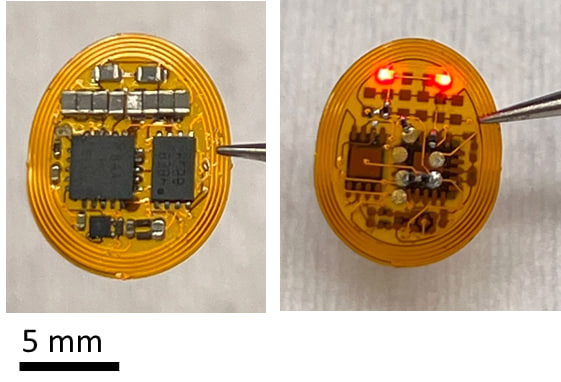
The implant, front and back.
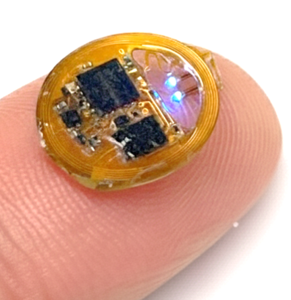
On a fingertip, LED on.
The problem
Studying how two brains synchronize during social behavior needs stimulation that is precisely timed across two animals, yet leaves them free to move and interact. Tethered fibers and battery-powered implants constrain the behavior being studied.
System overview
Sense
Overhead camera
→
Track
SLEAP + Bonsai pose stream
→
Decide
Python controller (location → mode)
→
Power
NFC reader + cage antenna
→
Act
μ-ILED implants, two mice
Design
Implant hardware
A battery-free NFC implant built around an ATtiny84 driving a μ-ILED. An 11 mF supercapacitor keeps it running through the brief RF-off gaps (≤15 ms) used to impose synchronization, so stimulation never drops out.
Closed-loop control
A Python controller reads the SLEAP pose stream from Bonsai over ZMQ, classifies where each mouse is in the cage, and switches the NeuroLux NFC system between tonic and burst stimulation. Along the way I found and fixed two bugs in the FEIG NFC reader library: a double-frame transmission and a wrong status-byte check.
Calibration at scale
To make every device behave the same, I built a MATLAB GUI with a full calibration state machine around a Moku:Pro, then tuned all 57 implants and analyzed their frequency spread.
Results
47 / 57
devices phase-locked within 2.5 mHz
≤0.1%
timing jitter
≤15 ms
RF-off gaps bridged by the supercap
What I did
Designed, assembled and programmed the NFC implants
Wrote the closed-loop Python controller and integrated SLEAP + Bonsai tracking
Debugged and patched the FEIG NFC reader library
Built the MATLAB calibration GUI and calibrated 57 devices
Trained the multi-animal SLEAP pose-estimation models